What Nearly Twenty Years Has Taught Me About Trust
John Tanner
Durable Labs
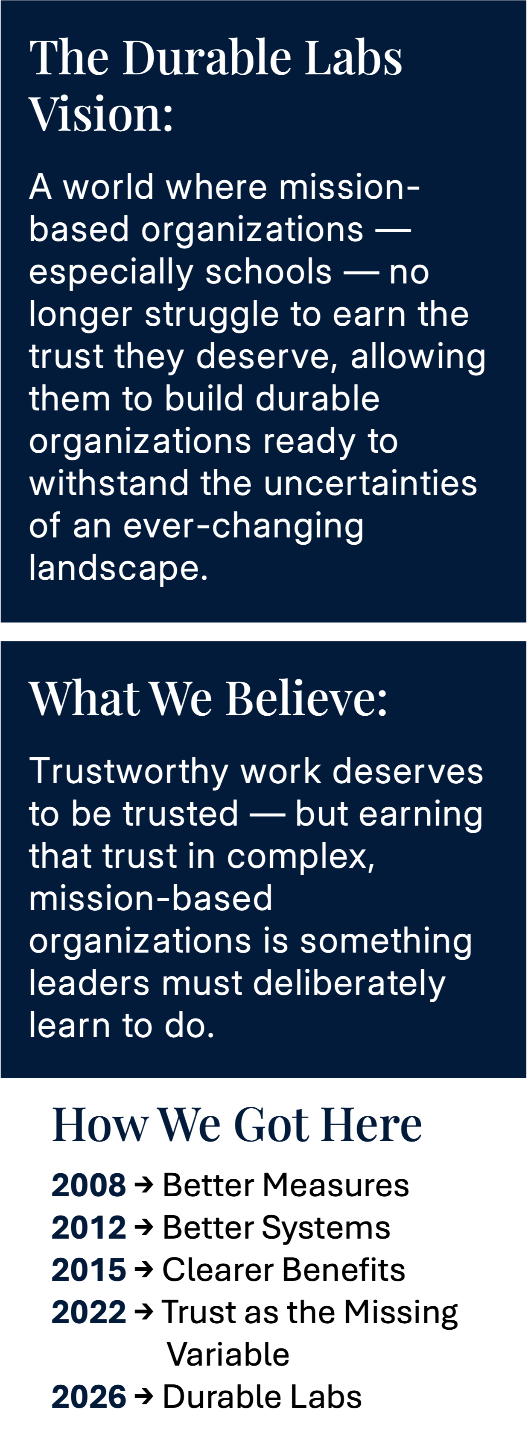
For almost two decades, my work has followed a steady progression toward a single question: What actually creates trust in mission-based organizations? Most notably, in schools.
The Measurement Phase
Early in that journey, the assumption was straightforward: the answers must lie in better tests, better metrics, or better measures. If organizations — especially schools — could measure performance more accurately, perhaps accountability systems could finally produce a meaningful outcome.
The Accountability Realization
That view changed quickly. The deeper problem was not simply the quality of the measures, though measures can always improve. The problem was the accountability models being chosen. Many modern accountability systems, particularly in education, were designed through legislative processes that assumed a generic model of accountability could meaningfully evaluate professional work. In hindsight, the surprising outcome would have been if those models had worked well, if at all. You would be hard pressed to find a profession that operates under an accountability system designed by outsiders with little grounding in the actual work being performed.
The Trust Realization
Over time, the focus shifted again — not away from accountability, but toward its true purpose. Meaningful accountings create trust between the person or organization offering the accounting and those receiving it. Accountability is meaningless unless it has the potential to create that very trust. I figured out how to build systems that can do exactly that, but what was remarkable was that it wasn’t the systems that created the trust, but the actions of every person in the organization as they built the capacity that could feed that system.
That realization carries major implications. It means that systems aren’t the solution. Accountability systems, it turns out, aren't the catalyst for trust I once thought they were. The catalyst is the need to be trusted by those you serve.
Schools — as but one example — will always have to have accountability systems given their role in society, but it is the capacity to build trust that matters most.
Trust is shaped far more by the day-to-day engagements of an organization than by the reports it produces. The way leaders communicate, the way decisions are made, the way evidence is used, the way priorities are maintained under pressure, and the feelings that engenders in those the organization serves — these are the things that determine whether organizations have the capacity for their trustworthy work to be trusted.
That insight led to the next major realization: an organization’s capacity to build trust is far more important than any individual accountability system it adopts.
Without that capacity, trustworthy work may never be recognized as trustworthy, regardless of any accountability system. If trustworthy work cannot be seen, understood, or trusted, even the most sophisticated system will fail to produce the confidence and clarity it was meant to create.
Durable Labs Was Born From That Realization
None of this is an abandonment of the pursuit of better accountability in education. Quite the opposite. It represents the missing step — the organizational capacity for building durable trust. Schools are in desperate need of a better accountability system, but that system should reflect the results of capacity, not the other way around.
The last ten years also revealed something else: this problem is not unique to schools.
Nearly every mission-based organization now faces the same challenge. Meaningful, trustworthy work is increasingly vulnerable to distortion, misunderstanding, ideological filtering, and narrative competition. In a world shaped by artificial intelligence, fragmented information, and declining confidence in shared facts, truth no longer speaks for itself in a way that resonates as trustworthy.
Organizations must now do more than good work.
They must ensure that their good work can be seen, understood, and trusted.
That is the work of Durable Labs.
We help mission-based organizations build the capacity to sustain trust, maintain mission integrity, and create truthful, evidence-based narratives that can withstand pressure and distortion.
As society enters its next phase, trust may prove to be the most valuable resource any organization possesses.
The organizations that learn to build it—and sustain it — will shape the future. We're here to help.
Why This Matters Now
The challenge facing mission-based organizations is growing. Truth no longer travels on its own, and good work no longer speaks for itself. Trust must be built intentionally or it risks not existing at all.
John Tanner
Founder